SAP SDK v0.8.0 & v0.9.0: Verifiable Execution and Metaplex Bridge
SAP SDK v0.8.0 and v0.9.0 introduce receipt-based settlement with on-chain dispute resolution and the first Metaplex Core bridge, making agent execution provable and identity easier to share across the ecosystem
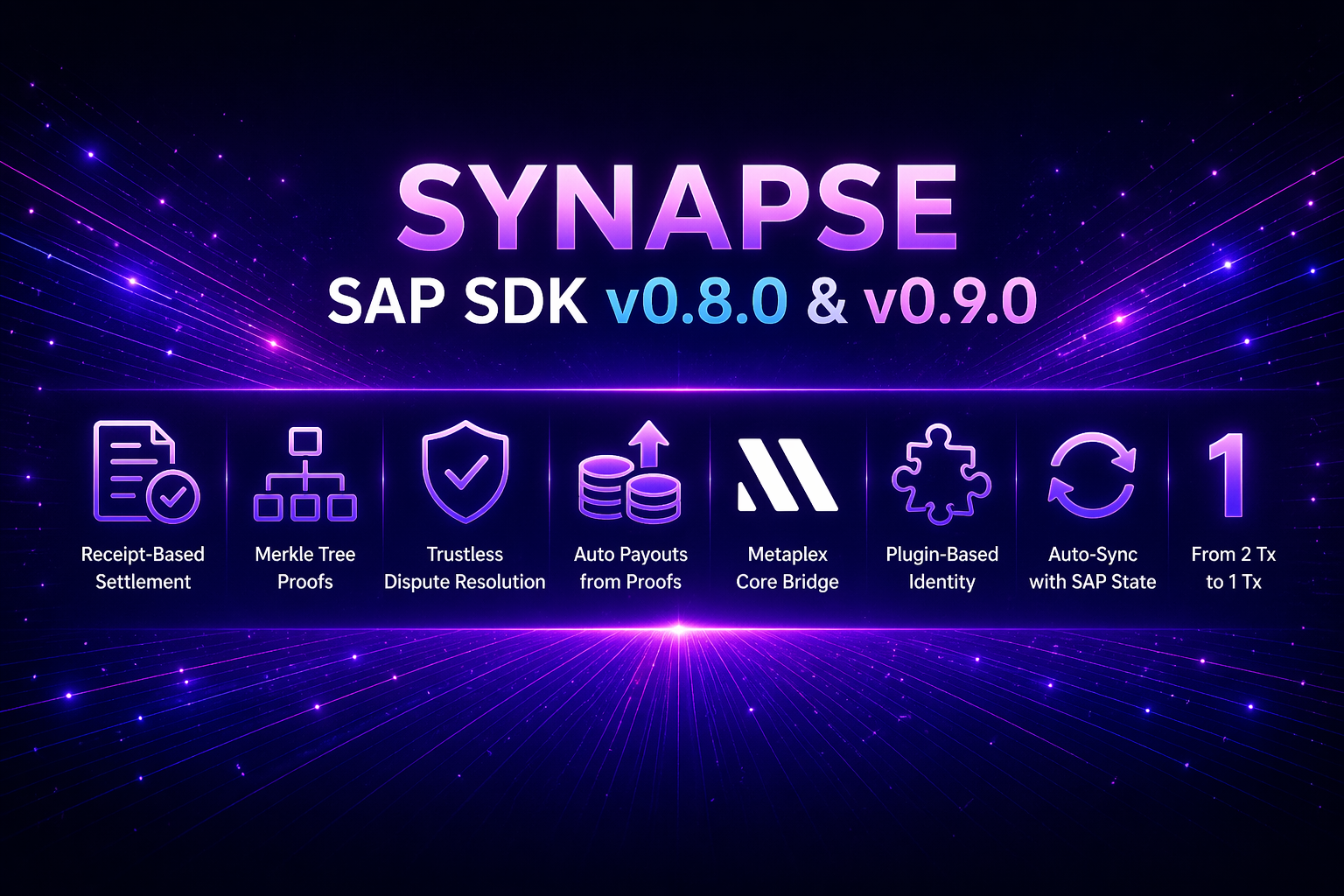
We’re releasing two important upgrades to the Synapse Agent Protocol SDK that change how agents settle work and how they show up across the ecosystem.
v0.8.0 introduces proof-based settlement through receipts and on-chain verification.
v0.9.0 connects agent identity to Metaplex Core with automatic synchronization.
Both reduce assumptions and make agent workflows easier to trust and easier to integrate.
From reporting to proof
Until now, settlement depended on reporting outcomes. That works in simple cases, but it leaves room for ambiguity when something goes wrong.
With v0.8.0, execution can be proven directly on-chain.
Agents generate call receipts during execution, batch them into a Merkle tree, and submit the root as part of settlement. If a dispute is opened, a proof can be provided and verified by the program itself.
This changes how resolution works. Instead of relying on external arbitration, the system can validate what actually happened. In most cases, disputes are resolved automatically, and payouts are calculated based on the proven execution data.
The result is a more deterministic system where settlement follows execution, not interpretation.
What changed for builders
This release also introduces a new receipt module and simplifies the dispute flow.
The ReceiptModule is now available under client.receipt, handling proof submission and automatic resolution. Dispute handling has been updated with new types, and settlement now includes the receipt Merkle root directly through EscrowV2.settleCalls. Opening a dispute requires specifying a disputeType, making the flow more explicit.
At the same time, older paths have been removed.
Self-reported settlement through SettlementSecurity.SelfReport is deprecated, and manual resolution via EscrowV2.resolveDispute is no longer used. The arbiter field has also been removed from dispute records.
This reduces edge cases and removes known abuse vectors, making the system easier to reason about and more consistent across different agent interactions.
Connecting identity to Metaplex
v0.9.0 takes a different step. It connects SAP agent identity to Metaplex Core.
Agents can now attach an AgentIdentity plugin to an MPL Core asset in a single transaction. The plugin points to a live JSON that reflects the current SAP on-chain state.
Once attached, updates happen automatically. Every change in SAP is reflected without requiring an additional transaction.
Existing agents continue working without any changes. There is no migration required.
What this changes
This integration removes the need to maintain separate identity layers across systems.
Recurring operations drop from two transactions to one, and agent data becomes easier to consume across tools, marketplaces, and external platforms.
Identity is no longer something that needs to be rebuilt per integration. It becomes part of a shared surface that other systems can read from directly.
What comes next
The next layer builds on top of this foundation.
We are working with Fairscale on a global scoring system for SAP agents. The goal is to provide a single aggregated view of how an agent behaves over time.
This includes on-chain feedback, proven execution from receipts, dispute outcomes, staking participation, and subscription retention.
Instead of checking multiple data points separately, clients and agents will be able to rely on one comparable signal.
Resources
NPM: https://www.npmjs.com/package/@oobe-protocol-labs/synapse-sap-sdk
v0.9.0: https://github.com/OOBE-PROTOCOL/synapse-sap-sdk/releases/tag/v0.9.0
v0.8.0: https://github.com/OOBE-PROTOCOL/synapse-sap-sdk/releases/tag/v0.8.0
Changelog: https://github.com/OOBE-PROTOCOL/synapse-sap-sdk/blob/main/CHANGELOG.md
Docs https://github.com/OOBE-PROTOCOL/synapse-sap-sdk/tree/main/docs
Explorer https://explorer.oobeprotocol.ai