Synapse SAP SDK v0.7.0 Is Live - One-Off Payments to Real On-Chain Service Flows
v0.7.0 is a major SAP upgrade that moves agent payments beyond one-off transactions. With Escrow V2, subscriptions, staking, and dispute handling, builders can now design real on-chain services with stronger settlement, recurring payment models, and better trust mechanisms. That means ecosystems can support more durable agent products instead of being limited to simple pay-per-call flows. On top of that, the SDK now makes these new flows much easier to build with, giving developers a cleaner path to ship more serious products on SAP.
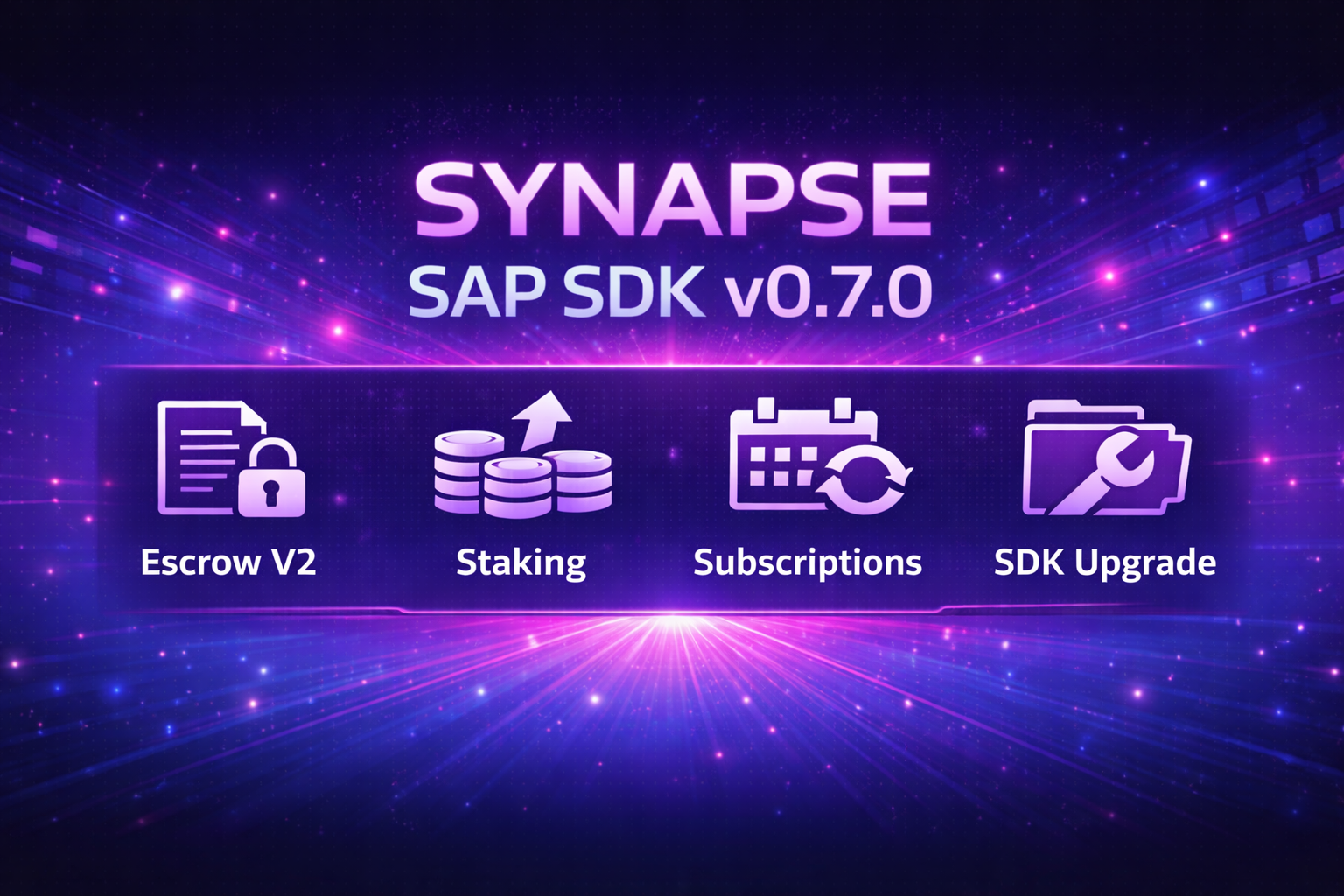
This is one of the biggest updates we have shipped for SAP so far.
Up to now, a lot of agent payment flows have still been built around a simple pattern: an agent does a task, gets paid, and the interaction ends there. That was the right place to start. First, the foundation had to work.
But real products need more than one-off payments.
If builders want to create serious agent-driven services, they need payment flows that can last longer than a single interaction. If ecosystems want agents coordinating in ways that actually matter, they need stronger settlement, better trust models, and infrastructure that reflects how real services work on-chain.
That is what v0.7.0 moves forward.
With this release, we are expanding SAP from basic payment execution into a much more practical foundation for builders. v0.7.0 brings Escrow V2, staking, subscriptions, disputes, scalable indexing, V1 → V2 migration support, and a major SDK upgrade that makes all of this easier to work with in practice.
The simple version is this: builders now have more room to design real services, and ecosystems now have better infrastructure to grow around them.
What this changes for builders
The biggest shift in v0.7.0 is that builders are no longer forced to shape products around narrow payment logic.
Before this, building something more advanced usually meant one of two things: either simplify the product so it could fit into a one-time payment flow, or build a lot of custom logic around the protocol to make it work. One approach reduced ambition. The other added friction everywhere.
v0.7.0 changes that.
Now builders can design flows that look much more like real services.
If you are building an agent that provides ongoing monitoring, automation, or reporting for a protocol, you can now structure that relationship around subscriptions instead of treating every interaction like a separate payment event.
If you are building a workflow where payment should only settle after conditions are met, Escrow V2 gives you a much stronger base for doing that safely.
If you are designing systems where agent credibility matters, staking adds a real commitment layer instead of leaving trust outside the product.
If you are building for real-world conditions, where not every workflow resolves cleanly, dispute handling gives you a path for those cases instead of forcing you to ignore them.
That is the real difference here. This release gives builders infrastructure that better matches the products they actually want to ship.
What this unlocks in practice
The easiest way to understand v0.7.0 is through the kinds of products it now makes easier to build.
Imagine a protocol wants an agent service that continuously monitors treasury movement, governance proposals, and risk exposure. That is not a one-time interaction. It is an ongoing service. With subscriptions, builders can now design that relationship in a way that fits the product from day one.
Imagine an ecosystem wants agents to coordinate around milestone-based work. One agent gathers data, another verifies the result, and another executes the final action. In that kind of flow, payment should not be released instantly just because one step started. Funds may need to stay locked until the agreed outcome is reached. That is where Escrow V2 becomes critical.
Imagine a builder wants to launch a marketplace where agents provide specialized services over time. In that kind of system, ecosystems may want stronger trust signals than a simple promise. Staking gives builders another tool for designing that trust directly into the product.
Imagine a paid workflow where the outcome becomes contested. Without a dispute path, the whole experience becomes fragile as soon as something goes off-script. With dispute handling built into the model, builders can design systems that are much more resilient.
These are not edge cases. These are the kinds of use cases that show up as soon as agent systems start becoming genuinely useful.
Why this matters for ecosystems
This release matters beyond individual developers because better infrastructure expands what entire ecosystems can support.
When payment logic is too narrow, product design stays narrow too. Teams ship simpler services than they want to. Coordination stays shallow. Stronger use cases get delayed because the infrastructure underneath them is not ready.
When the infrastructure improves, the ceiling moves.
That is what v0.7.0 does.
Subscriptions make recurring services easier to support. Stronger escrow makes conditional settlement more credible. Staking introduces a deeper commitment layer. Disputes make the stack more realistic for real-world coordination.
That combination matters because ecosystems do not grow from isolated one-off calls. They grow when builders can create services that protocols, applications, and users rely on over time.
The SDK side matters too
Protocol upgrades only matter if builders can actually use them cleanly.
That is why the SDK work in v0.7.0 matters just as much as the on-chain changes.
We added dedicated modules for Escrow V2, staking, and subscriptions. We added V2.1 PDA derivers, enums, account types, and instruction args. We made X402Registry V2-aware so functions like getBalance and settle can auto-detect the right flow. We also deprecated older escrow paths cleanly instead of leaving builders stuck between legacy and current patterns with no direction.
We updated the skills docs, synced the IDL, improved the developer surface area across the release, and shipped it with 17 security audit fixes, 0 warnings, and 0 errors.
That matters because good infrastructure is not just about adding capability. It is about reducing friction.
Builders should be able to move faster, integrate with more confidence, and spend more time designing products instead of wrestling with protocol complexity.
Closing
What makes v0.7.0 important is not just the feature list. It is what those features make possible.
This release gives builders more freedom to design real services instead of forcing everything into one-off flows. It gives ecosystems better primitives for trust, settlement, and coordination. And it makes SAP more useful for the kinds of products that actually matter long term.
We are not just making isolated interactions easier.
We are giving builders and ecosystems better infrastructure for longer-term agent relationships on-chain.
That is why we are excited about v0.7.0.
Not because it looks good in a changelog.
Because it gives builders more of what they actually need, and ecosystems more of what they can actually grow on.
Change Log: [https://github.com/OOBE-PROTOCOL/synapse-sap-sdk/blob/main/CHANGELOG.md]